
What to Make with Chicken Thighs: Five Families That Cover Everything
7 minute read | SavorovaS Learn
Five families, one forgiving cut
Chicken thighs belong to five dish families: braise, roast, grill, poach then chill, and shred for filling. Each works because a thigh carries more fat and connective tissue than a breast, so it tolerates both long cooking and high heat. Pick a family, make one technique decision, and you can skip the recipe entirely.
A thigh holds roughly twice the fat of a breast and far more collagen. That single fact explains everything else on this page. Collagen turns to gelatin under sustained moist heat, which is why a thigh is better at ninety minutes and a breast is ruined at forty. Fat does the second job: as moisture leaves, fat keeps the meat from reading dry.
So the breast has two viable methods and the thigh has five. That is not a flavor opinion, it is structure.
One safety floor applies to all five, so it is worth stating once. The temperatures below are texture targets, not safety minimums. Poultry is cooked safely at 165 F, and every method here holds the meat well above that for far longer than pasteurization needs, so none of them are shortcuts past doneness. If you pull at the low end of a band, check the meat with a thermometer rather than the clock.
Braise: the family that rewards neglect
Dishes: chicken adobo, coq au vin, and a yogurt-based chicken curry.
One technique note: keep the braising liquid, not the meat, in the 160 to 180 F band (71 to 82 C). That is the gentle end of a braise; conventional braising liquid more commonly runs 180 to 200 F, which works faster but gives you less margin. Judge the pot by the liquid temperature and judge the meat by its own reading, and you will stop cooking to the clock.
Acid in the braise, vinegar in adobo or wine in coq au vin, does little tenderizing beyond the surface. Its real job is balancing the sauce. Brown the pieces first if you want the braising liquid to taste like something.
The other half of a braise is what happens at the end. Skim the fat, then reduce the liquid until it coats a spoon, because a braise that tastes thin is usually one that was never reduced. If it tastes flat rather than thin, that is acid, and a spoonful of vinegar at the end will do more than another hour of cooking.
Roast: dry surface first, skin-side down
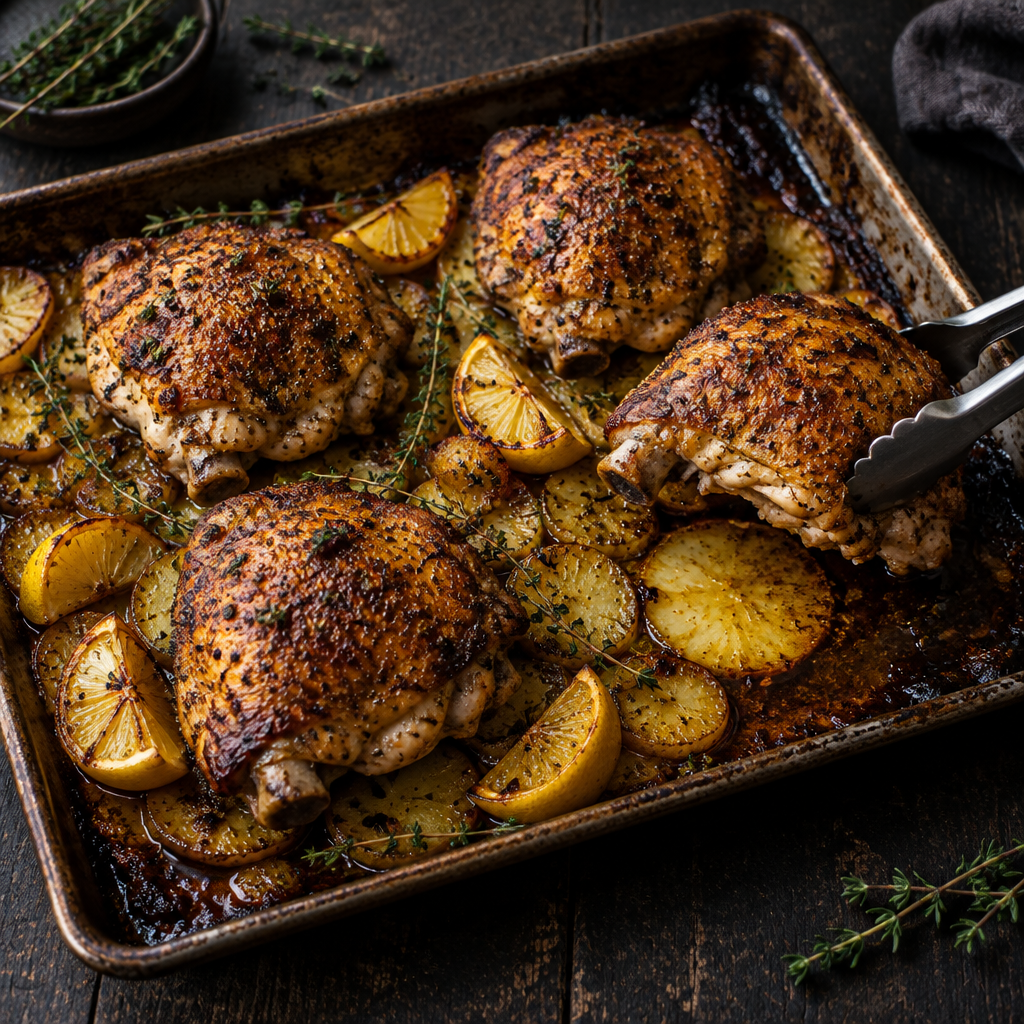
Dishes: thighs over potatoes and lemon on a sheet pan, thighs on a bed of sliced onion and fennel, paprika-rubbed thighs at high heat.
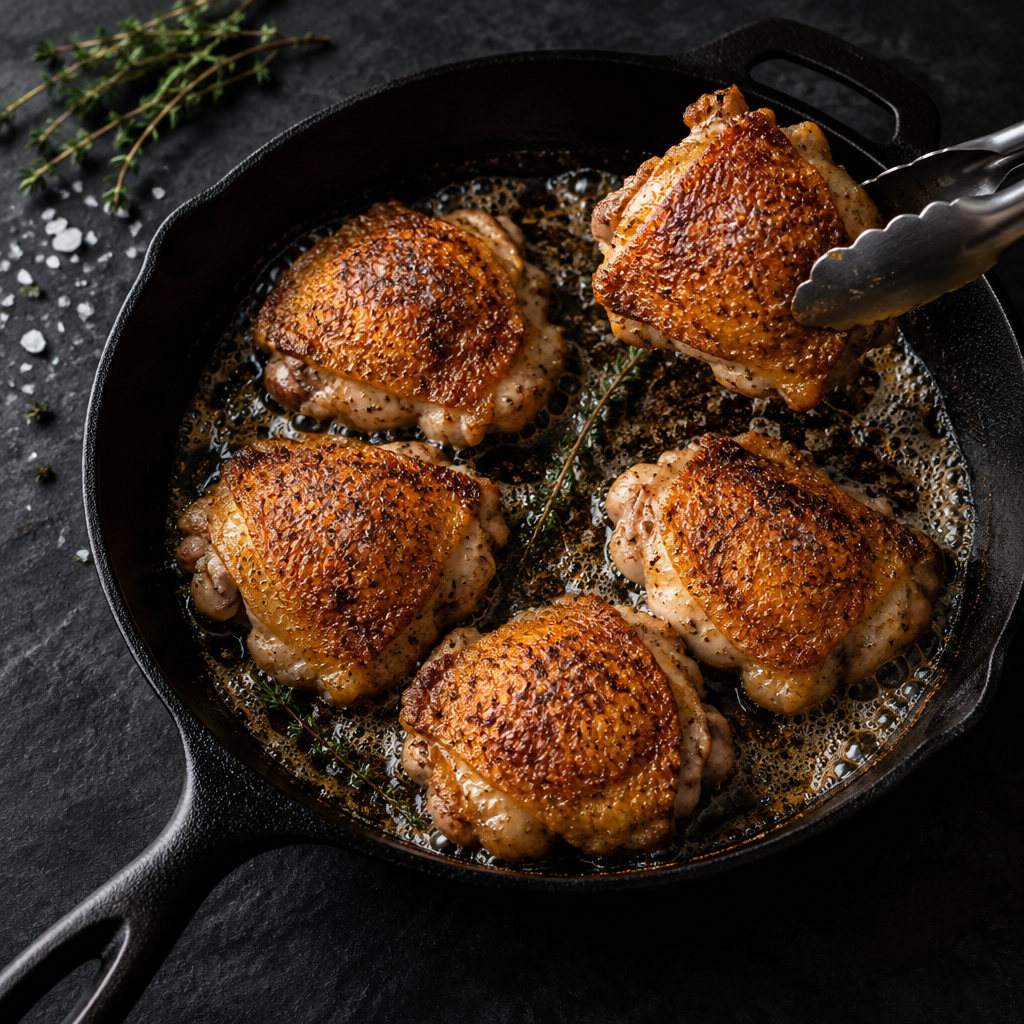
One technique note: skin has to be dry to brown. Water on the surface holds the temperature near the boiling point, and browning needs a surface well above 300 F (150 C). Pat the skin dry, salt it, and give it a dry start, skin-side down, so the fat renders and the skin crisps before the meat overcooks.
A bed of sliced potato underneath catches the drippings and is the reason this is a weeknight dinner rather than a project.
Salt early if you can. An hour in the fridge, or overnight, dries the skin and seasons the meat through, and that is most of the difference between good skin and great skin.
Grill: two zones, because the fat will flare
Dishes: yogurt-and-cumin skewers, harissa thighs, soy-and-ginger grilled thighs.
One technique note: build two heat zones. Thigh fat dripping onto coals makes flare-ups, and a flare chars the outside before the inside is anywhere near done. Sear over the hot side for color, then move to the cool side to finish. A yogurt marinade earns its place here because it clings, carries spice, and buffers the surface slightly.
Once the fat starts dripping, stay at the grill. A thigh over direct heat wants turning once, maybe twice; every extra turn costs you crust you already built.
Poach then chill: the one home cooks skip
Dishes: Chinese-style poached chicken with ginger-scallion oil, a French pot-au-feu style poach, cold sliced thigh over cucumber with sesame.
One technique note: hold the liquid at 160 to 170 F (71 to 77 C) and never let it boil. A boil contracts the muscle fibers and squeezes out the moisture you are trying to keep. A bare sub-simmer gives you meat that slices clean and stays silky.
Cool the pieces in the broth, not on a plate, so they stay moist as they chill.
Shred for filling: cook past done on purpose
Dishes: taco filling, a braised sandwich, dumpling filling.
One technique note: here you want to overshoot. Shredding wants 190 to 200 F (88 to 93 C), where the collagen has fully melted and the fibers fall apart under a fork instead of tearing. Cook it only to sliceable and you will be chopping it into rags instead of pulling it into strands.
The five families at a glance
Read the third column as the whole recipe. Everything else is detail you can adapt.
| Family | Best prep | The decision that matters | Rough time |
|---|---|---|---|
| Braise | Bone-in or boneless, browned first | Hold the liquid at 160 to 180 F for collagen | 60 to 90 min |
| Roast | Skin-on, patted dry | Dry surface, skin-side down first | 35 to 45 min |
| Grill | Boneless, marinated | Two zones to dodge flare-ups | 15 to 20 min |
| Poach then chill | Boneless, skinless | Sub-simmer, never a boil | 25 to 30 min, then chill |
| Shred | Boneless, braised | Cook past done on purpose | ~90 min (to 200 F) |
You do not need thirty recipes, you need a method and a list
The five families above cover nearly every chicken thigh dish you will meet, and each one is a technique decision rather than a set of instructions. Once you know that braising wants a temperature band, roasting wants dry skin, grilling wants two zones, poaching wants gentleness, and shredding wants overshoot, the recipe becomes a detail.
Which means the useful thing to buy is not another cookbook. It is a shopping list: thighs, onions, garlic, lemons, a vinegar, a chile, and something with umami in it. Those six cover all five families, and the dish you make is whichever one your evening has room for.
Put what is already in your kitchen into the builder and it will turn one of these five families into tonight's recipe, with the shopping list for whatever you are actually missing.