Egg Cookery: The Complete Guide: Boiled, Scrambled, Poached, and Fried
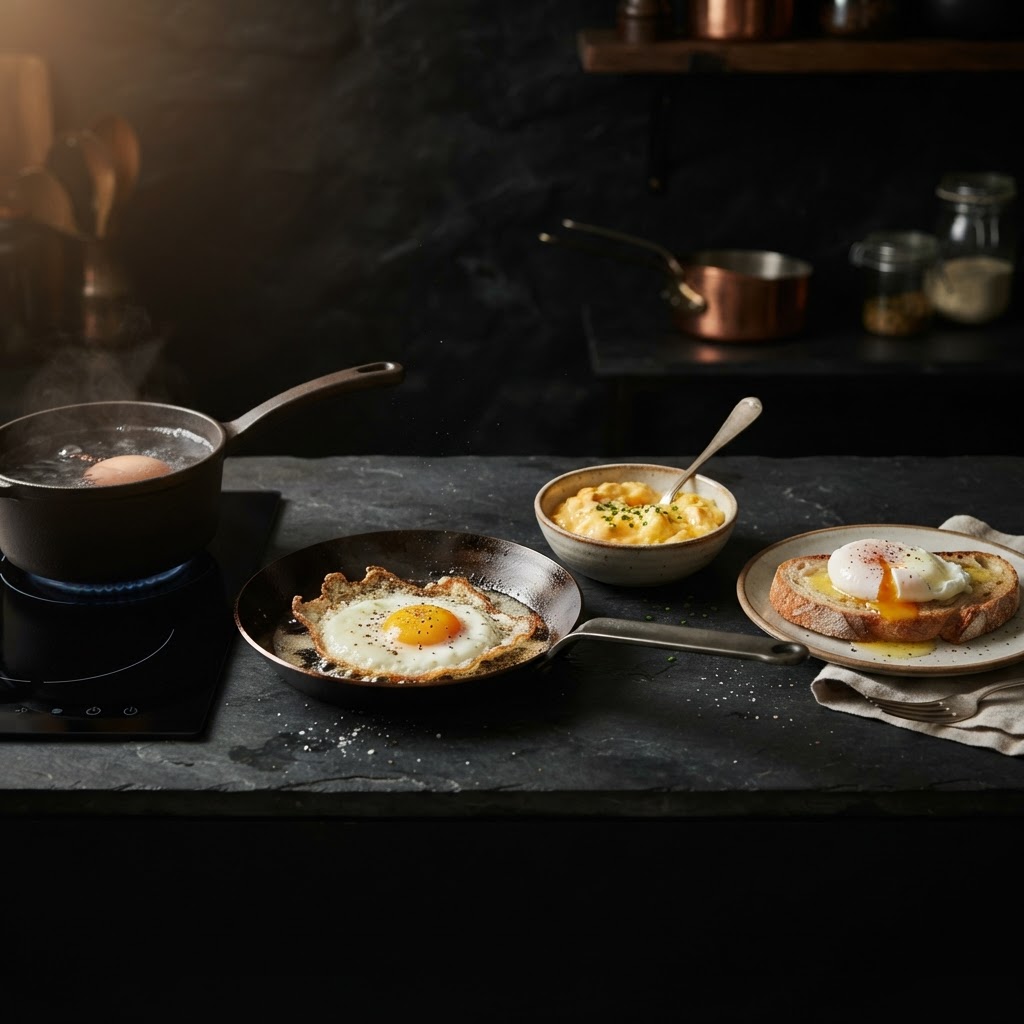
The egg is the benchmark
Every culinary school audition and every restaurant trail shift begins the same way: cook an egg. It is not tradition, it is a test with no place to hide. An egg is protein and water in a shell, and what heat does to it happens in front of your eyes, in minutes, at temperatures you control. There is no sauce to mask an error and no seasoning to rescue one.
That makes the egg the purest lesson in heat control, timing, and observation in the entire kitchen. Master the egg and the rest of egg-shaped problems, custards, scrambles, even stocks, start answering to you.
The science: two proteins, two temperatures
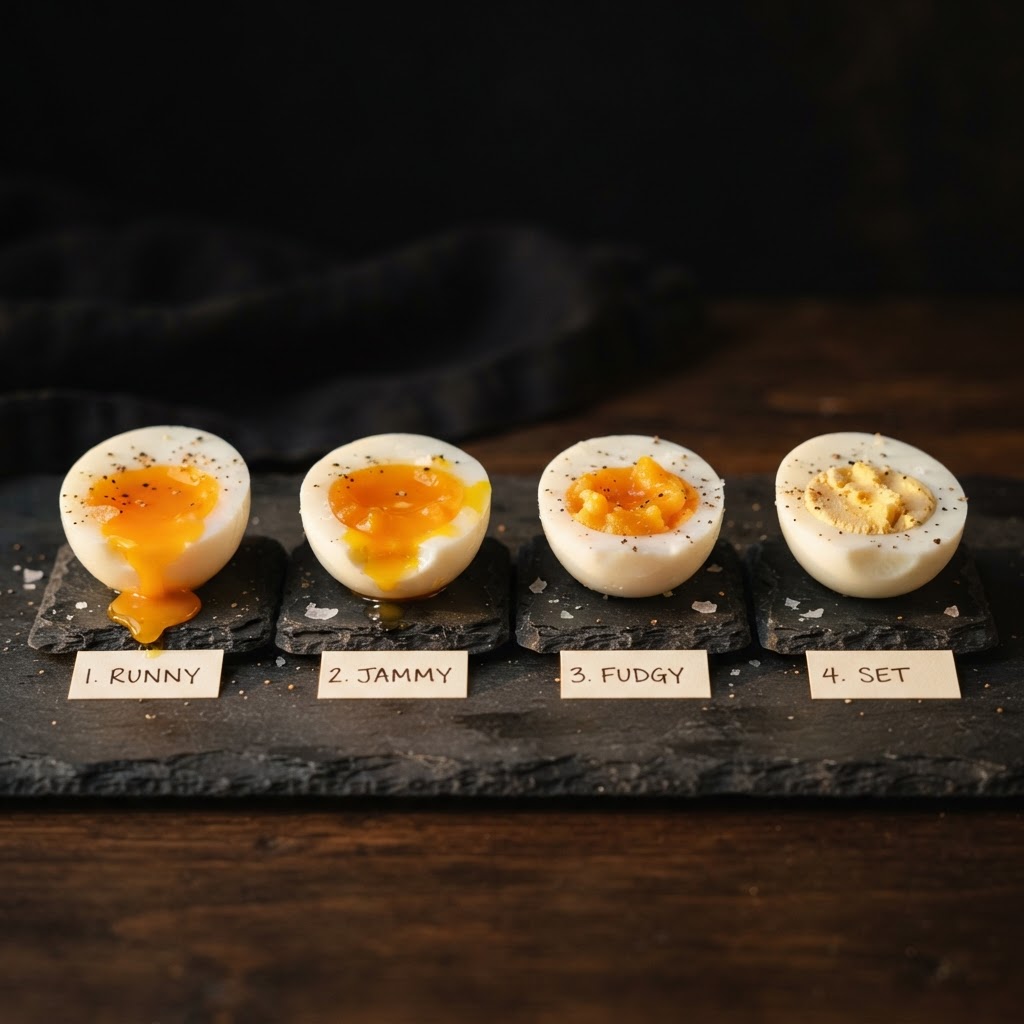
The white and the yolk are different mixtures that set at different temperatures. The white's proteins begin to coagulate around 140 degrees F and are not fully set until about 180. The yolk's proteins set between about 150 and 158. That gap is the entire craft of egg cookery, because it means the white can be firm while the yolk is still liquid.
Every egg technique in this guide is a way of landing inside that window: soft-boiled exists because the white sets first, creamy scrambled exists because low heat keeps curds below the yolk's set point, and the gray-green ring on a ruined hard egg is iron from the yolk binding sulfur from the white, visible proof of overshoot.
Food safety line, stated once: the consumer standard for fully cooked egg dishes is 160 degrees F. Soft yolks are a doneness choice; anyone pregnant, immunocompromised, or serving those who are should choose fully cooked.
Boiled: one method, one chart
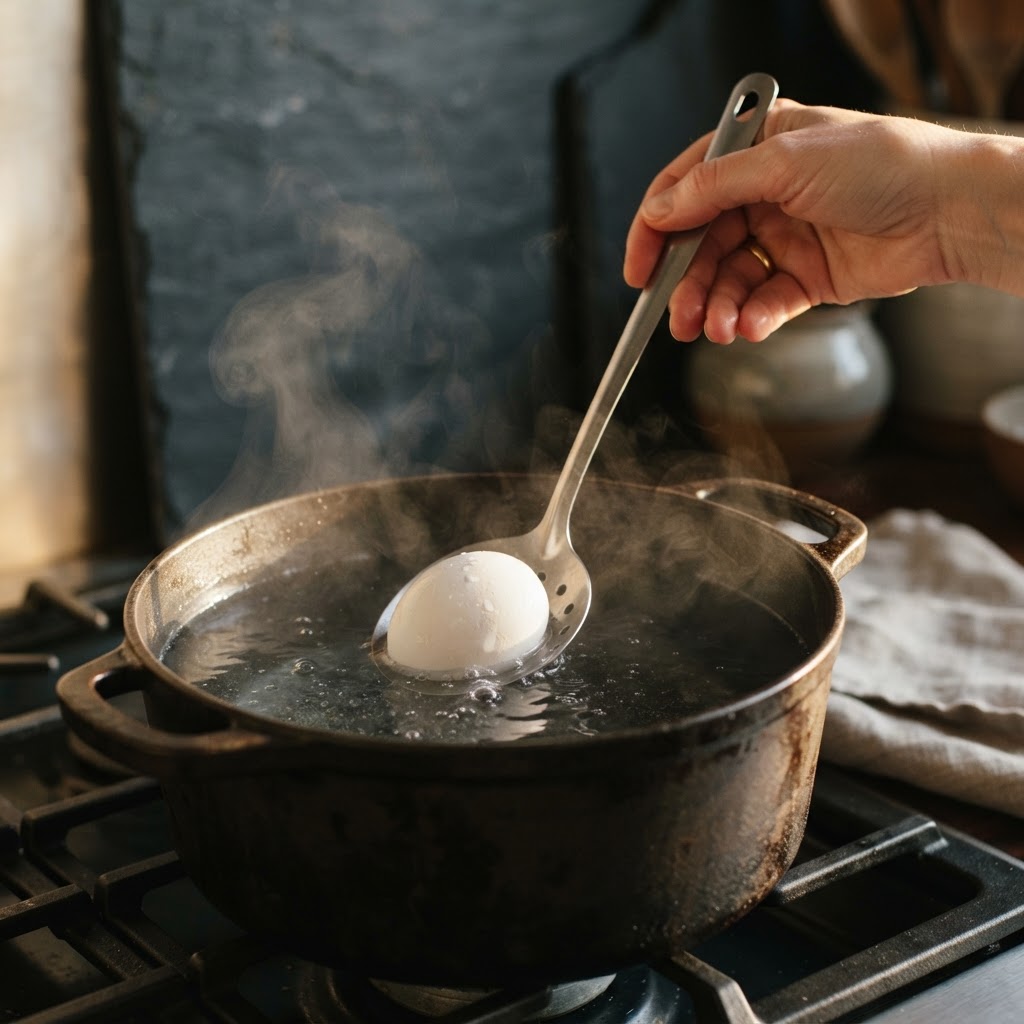
Boiled eggs fail because the clock, not the cook, was wrong. Remove the guesswork by standardizing the start: bring a pot of water to a boil, lower refrigerated eggs in gently with a spoon, let it return to a rolling boil for 30 seconds, then drop to a bare simmer and start the clock. The eggs go into known-temperature water every time, regardless of your stove.
When the timer sounds, transfer immediately to an ice bath. This stops carryover cooking and pulls the egg slightly from the shell, which is half of easy peeling.
| Doneness | Yolk result | Medium | Large | Extra large | Jumbo |
|---|---|---|---|---|---|
| Runny | Loose, flowing yolk; white barely set | 5:00 | 6:00 | 6:30 | 7:00 |
| Jammy | Molten-cream center; the ramen egg | 5:45 | 6:45 | 7:15 | 7:45 |
| Fudgy | Just set but tender; the salad egg | 7:00 | 8:00 | 8:30 | 9:00 |
| Fully hard | Pale, crumbly, sliceable | 10:00 | 11:00 | 11:30 | 12:00 |
Two adjustments worth knowing
Steaming instead of boiling, eggs on a rack over an inch of boiling water, runs about the same for soft eggs and up to a minute longer for hard, and produces eggs that peel noticeably more easily. At high altitude, where water boils cooler, add about one minute per row. The chart above assumes fridge-cold eggs, a boiling-water start, and an immediate ice bath.
Peeling, and the green ring
Peeling trouble is almost always freshness, not technique. A fresh egg's inner membrane clings to the shell; as an egg ages, carbon dioxide escapes, the white's pH rises, and the membrane releases. Week-old eggs peel; farm-fresh eggs fight. Steam them, shock them hard in ice water, and peel under a trickle of running water starting from the air-cell end, the wide end, where the membrane separates first.
The green-gray ring around an overcooked yolk is iron sulfide, formed when heat drives hydrogen sulfide from the white inward to meet iron at the boundary. It is harmless but it is a clock reading: it means the egg overshot the chart or sat hot. Shorter cook, faster chill, no ring.
Scrambled: temperature is the whole game
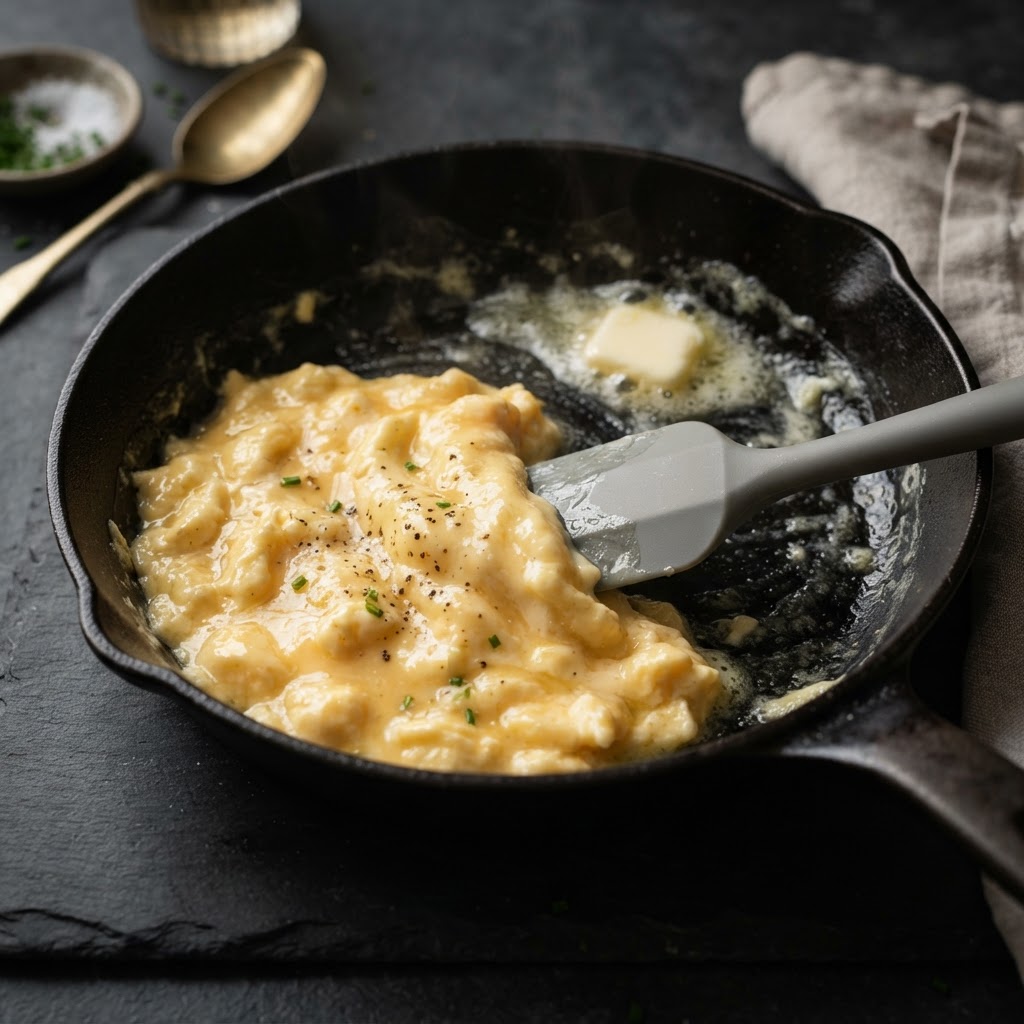
Scrambled eggs are a coagulation study in real time. Curds form when proteins set; their size is set by your heat and your stirring. Low heat plus constant motion makes small, tender curds. High heat plus laziness makes rubbery sheets.
Beat the eggs with a pinch of salt just before cooking. Put them in a pan over medium-low heat with butter and stay with them: stir, scrape, and fold continuously, pulling solidified curd off the bottom and letting liquid egg take its place. Remove them from the pan while they still look glossy and slightly loose. Residual heat finishes the job in the thirty seconds it takes to reach the plate. That patience gap, glossy in the pan, set on the plate, is the difference between restaurant scrambled and diner rubber.
Dairy is optional and does one thing: butter, milk, or cream raises the coagulation temperature slightly and interrupts the protein network, making softer, moister curds. It is a texture tool, not a requirement.
Poached: freshness plus a simmer
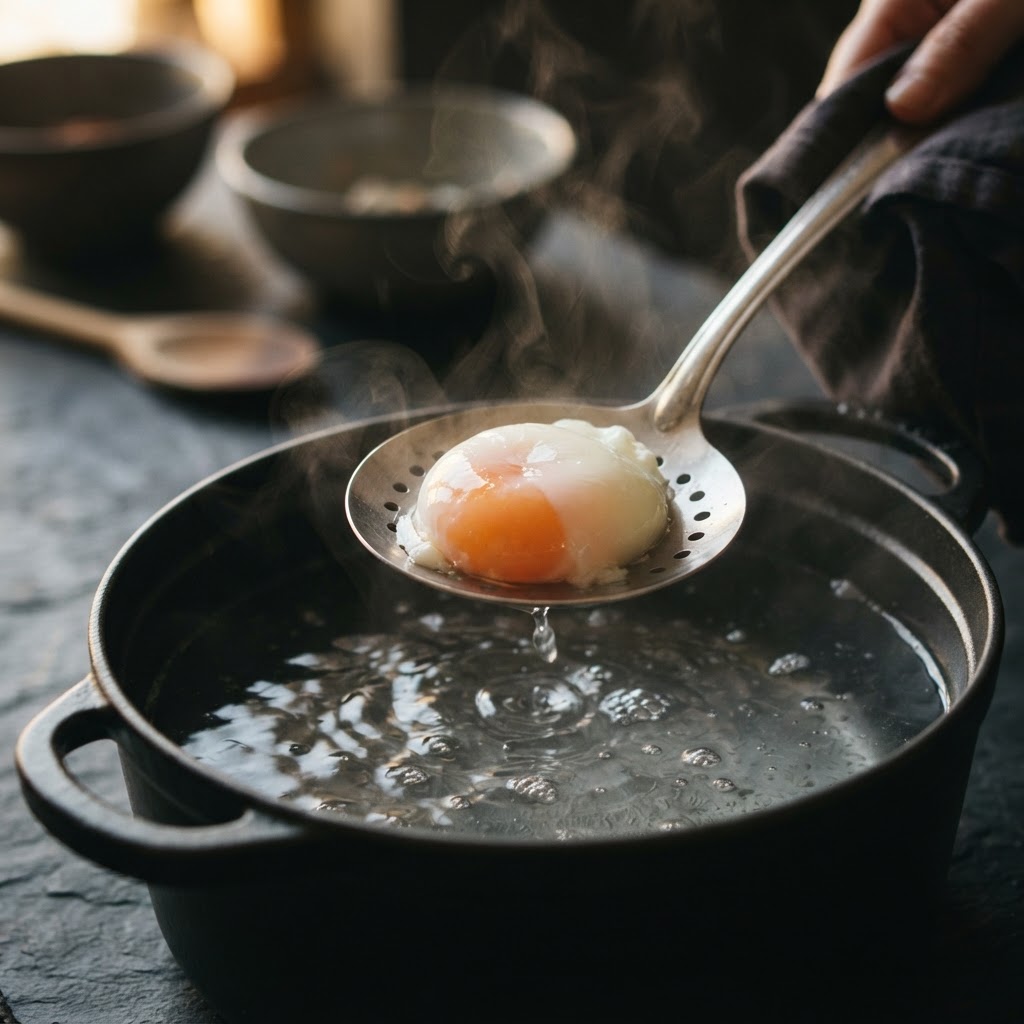
Poaching works when the outer white sets before it has time to disperse. Three conditions deliver that. First, freshest-possible eggs: the thick white of a fresh egg holds the egg together while old egg white dissolves into the pot as streamers. Second, water at a bare simmer, around 190 degrees F: a rolling boil tears the egg apart before it can set. Third, a splash of vinegar, about a tablespoon per quart: acid speeds the outer white's coagulation.
The restaurant refinement: crack the egg first into a fine strainer and drain off the thinnest, loosest white for ten seconds, then slide the strained egg into the water. The streamer whites never make it to the pot and the poached egg comes out compact and clean. Three minutes for a large egg, lifted with a slotted spoon, drained on a towel. The yolk should swell under the surface and break under pressure.
Fried: the three jobs of fat
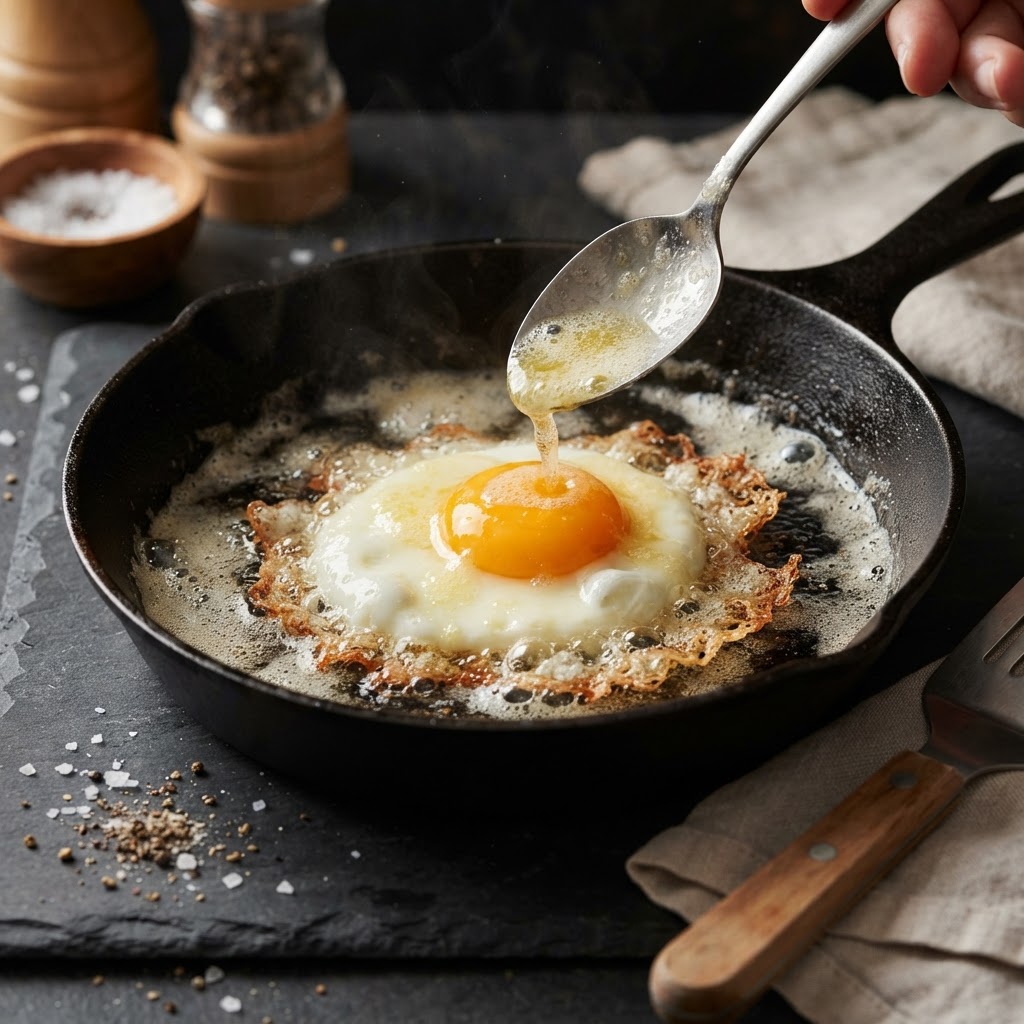
A fried egg is a frying lesson wearing a breakfast costume. The fat in the pan does three jobs: it conducts heat to the white evenly, it crisps the edges, and it carries flavor. What style you want determines the heat and the amount.
For soft whites and a runny yolk with no lace, use a generous film of butter over medium heat and baste the cooking white with hot fat from the spoon, which sets the top surface without flipping. For a crispy, lacy-edged egg, more fat and hotter: the edges bubble and frill into brown shards while the yolk stays liquid. To set the top without basting, add a teaspoon of water and cover the pan for the last thirty seconds and let steam finish the white. The flip is for eggs over: turn only once the white is fully set, and count 20 to 30 seconds more for over easy, a full minute for over hard.
The slow egg: the window made visible
There is one more egg worth knowing, and it demonstrates the coagulation window better than any diagram. Hold a whole egg in a 145 degree F water bath for 45 minutes and you get onsen tamago, the Japanese hot-spring egg: a white just barely set into custard, and a yolk that holds its shape but flows when broken. It is impossible on a stovetop, because no burner holds that narrow band between white-set and yolk-set steady for 45 minutes, and it is effortless with a thermostat.
The lesson generalizes: the texture of any egg dish is the temperature it reached, held for the time it was held. Eggs respond to heat the way a musician responds to a metronome. Precision in, texture out.
The diagnostic table
Find the symptom, apply the cause, keep the fix for the next egg.
| Symptom | Probable cause | Prevention or fix |
|---|---|---|
| Green-gray ring around the yolk | Overcooked, or held hot after cooking | Follow the chart, shock in ice water immediately |
| Rubbery hard-boiled white | Rolling boil the whole time; overcooked | Bare simmer, not a boil; pull at 11 minutes for large |
| Shell clings, cratered whites | Eggs too fresh | Age eggs a week, steam instead of boil, or peel under running water from the wide end |
| Whites stream and feather when poaching | Old eggs, boiling water, no acid | Freshest eggs, bare simmer, splash of vinegar; strain loose white first |
| Poached white ragged but intact | Egg cracked straight into moving water | Lower the egg on a spoon into a still spot, or use the strainer method |
| Scrambled eggs weep on the plate | Cooked dry in the pan; no carryover left | Pull while glossy; the plate finishes them |
| Scrambled curds dry and separate | Heat too high, under-stirred | Medium-low, constant motion, optional splash of dairy |
| Fried edges burnt, yolk raw | Pan too hot | Medium heat; for lace, add fat, not temperature |
| Yolk breaks when frying | Egg cracked on the pan rim or dropped from height | Crack into a bowl, slide in low, and cook fresher eggs |
| Boiled eggs crack in the pot | Cold eggs shocked into rolling water | Lower gently, or start cold; a teaspoon of vinegar in the water helps contain escaping white by coagulating it |
Buying and storing: what grade means
Eggs are graded on interior quality by proxy of the air cell, the pocket at the wide end that grows as the egg ages. Grade AA has a small air cell and a tall, standing yolk; Grade A, the supermarket standard, is a touch wider and flatter. The float test reads the same variable: a fresh egg lies flat, an older egg tilts, a floating egg is past eating.
American eggs are washed before sale, which removes the protective cuticle, so they belong in the refrigerator, where they hold three to five weeks. Hard-cooked eggs keep one week. Brown versus white is the hen's breed and nothing else. And match the egg to the job: older eggs for boiling, the freshest eggs you can get for poaching and frying.
SavorovaS is an Amazon Associate. Some links on this page are affiliate links, and we earn from qualifying purchases. We recommend products based on professional kitchen practice, not on commission.
Cook with Savi